Back in 2017, Instagram launched a bookmarking feature called “collections,” which allows users to organize the posts they save into private groupings for easier access. Now, Instagram is introducing a new feature that lets users create collections with their friends.
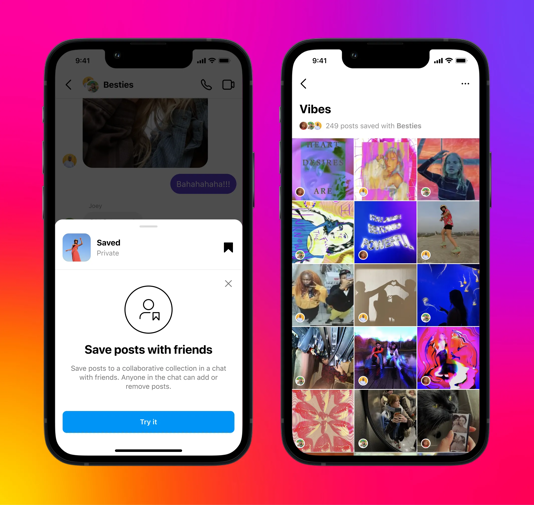
The social network told TechCrunch in an email that it’s rolling out “collaborative collections,” a way for people to connect with friends over their shared interests by saving posts to a collaborative collection in their group chat or a one-on-one DM. In other words, you can now share posts with a friend of a group of friends and save them in a dedicated space.
“Now when you go to save a piece of content on Feed or from your DMs, you’ll see a new option to create a collaborative collection,” Instagram head Adam Mosseri said on Wednesday in the IG Updates Channel on Instagram. “From there you can give the collection a custom name and share the collection with your friends. Once they receive it, your friends can start adding content from reels, Explore, Feed and DMs to the collection as well.”
Any member of the chat can add or remove posts from the collection. Users also have the option to add posts shared in a chat directly to a collaborative collection. If there is a post in a chat that you want to add to a collaborative collection, you can tap the bookmark icon that appears next to the post and then either add it to a current collaborative collection or create a new one.
The new feature could be seen as a way for Instagram to compete with Pinterest, which has offered a “Group boards” feature since 2018, letting users collaborate with each other on the platform.
Collaborative collections is a welcome addition to the platform and has numerous use cases. For instance, the feature could be used to help a group of friends plan a trip by allowing them to save posts of places they want to see or things they want to try when visiting a new place. Or, collaborative collections could be used for day-to-day things like curating a dedicated space where you and your friends can share posts about your mutual interests, such as memes, baking recipes, workout tips, craft ideas and more.
The launch of the new feature comes as Instagram recently introduced a new way for users to connect with others on the social media platform. Last month, the company rolled out a new broadcast chat feature on Instagram called “Channels.” The feature lets creators share public, one-to-many messages to directly engage with their followers. Channels support text, images, polls, reactions and more
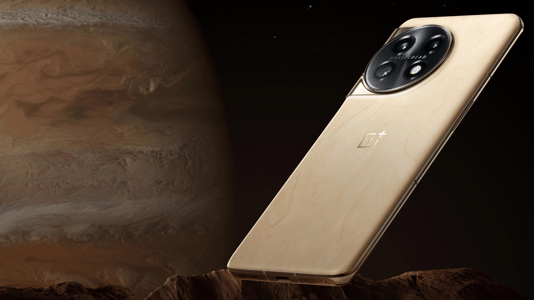
The OnePlus 11 Jupiter Rock edition has made its debut, giving users a new color option when it comes to the recently released smartphone. The color itself looks quite different from what we have seen in the past, and with good reason, as the company has used a unique material to produce the stunning look. OnePlus is touting the use of 3D microcrystalline rock, which it states is a first in the smartphone industry. This limited edition model will only be available in Asia for the time being, with no plans for an international release in the immediate future.
According to OnePlus, the company spent a year to get this new material to market. Furthermore, it seems like an incredibly difficult material to produce, with the firm sharing that it has an extremely low yield rate when compared to its standard glass back found on the normal models. What makes this process even better is that no two 3D microcrystalline rock back panels are alike, with each having a slightly unique and different pattern, making your OnePlus 11 Jupiter Rock edition truly different.
But the 3D microcrystalline rock back panels aren’t just great to look at, as it also provides a different tactile feel when compared to traditional glass. The company describes the sensation as a “cool and skin-friendly feel” which is like “jade that has been washed for thousands of years.” While it’s hard to say exactly what the feeling is like, most likely due to the poor machine translation, but for the most part it probably feels extremely smooth to the touch and is also quite cool, just like how stone would be.
As you might expect, the company has also gone all out when it comes to the packaging, with the Jupiter Rock color being used for all the packing materials, and a 3D microcrystalline rock SIM card removal tool being included as well. As far as the internals go, you can expect the same powerful components found on the standard OnePlus 11 model, like Qualcomm’s Snapdragon 8 Gen 2 processor, 16GB RAM and 512GB of internal storage.
You’ll also get the same 2K AMOLED display with curved edges and a 120Hz refresh rate. On top of all of that you get a robust triple camera setup, co-engineered with Hasselblad, and a large 5,000mAh battery that can charge quickly thanks to its 100W wired charging speeds. As stated before, the handset will only be available in China and India, with the price coming in at ï¿¥4,899 in China or around $711. There is no word on pricing for India. So, if you’re in the region, you can head to the source below to place your order. Otherwise, you’re probably going to be out of luck unless you can find it for a reasonable price from a reliable importer.
Stop me if you’ve heard this one before: ChatGPT is huge right now. After exploding in popularity in late 2022, the AI chatbot has been on an enormous rise, with no sign of slowing down. One of the ways we’ve seen ChatGPT expand is its continued integration into smartphone apps. Whether it’s Bing Chat coming to mobile or a ChatGPT iPhone keyboard, it’s all been fascinating to watch unfold.
One of the latest ChatGPT mobile apps to hit the scene is one called “Perplexity AI,” which is an iPhone app that brings ChatGPT directly to your smartphone. And it does so with a sleek interface, helpful features, and zero ads. Best of all? It’s 100% free to use. I’ve been playing with the app on my iPhone 14 Pro for about a day now, and I’m seriously impressed with what I’m seeing.
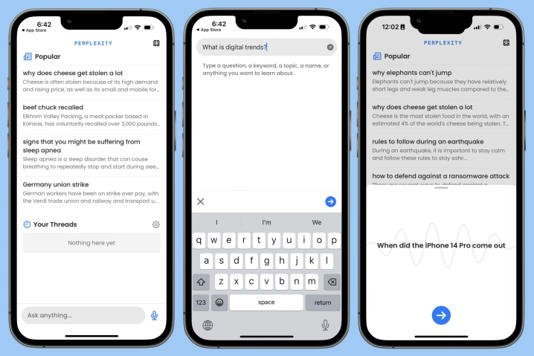
What makes Perplexity AI so good? It all starts with how simple the app is to use. After downloading it from the App Store, you’re ready to start using it instantly. You don’t have to make an account or pay anything — just download Perplexity AI and start asking it questions.
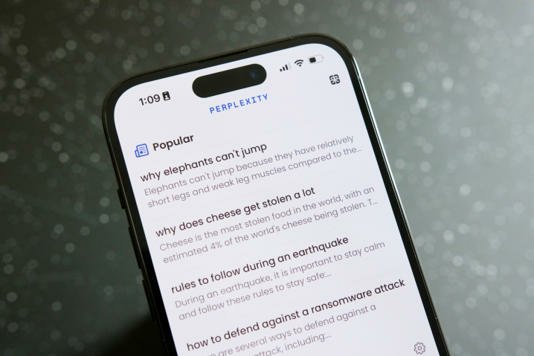
The top of the app shows popular search terms that other Perplexity AI users are searching for. As you use the app, you’ll see a collection of your own search history toward the bottom.
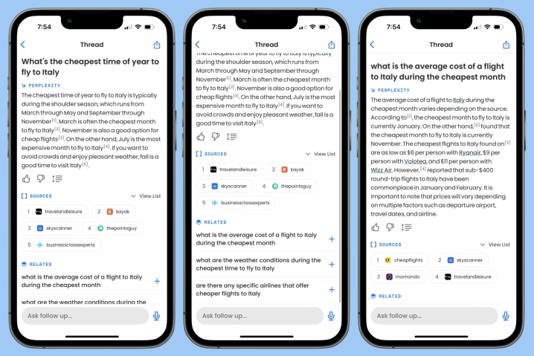
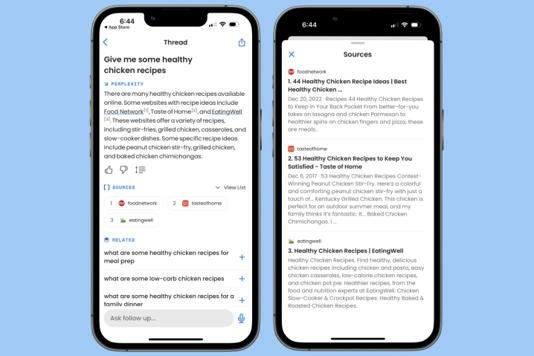
When you’re ready to ask a question, you have two options: tap the Ask anything button to write a prompt with your keyboard, or tap the microphone icon to use your voice. Like other ChatGPT applications, you can ask Perplexity AI whatever comes to mind. Looking for the best restaurants in your area? Wondering what the best time of year is to visit Italy? Need a recipe for the best brownies ever? No matter what’s on your mind, chances are Perplexity AI has an answer for you.
This is ChatGPT as it should be
How is any of this different from Bing Chat and other ChatGPT applications? While the core functionality is the same, Perplexity AI does a few interesting things that really make it stand out from the crowd.
For starters, the app is incredibly sleek in all the right ways. The interface is clean and simple without any unnecessary cruft. Tapping the search bar or using your voice to ask a question results in lovely animations. And most important of all, the speed at which Perplexity AI gives you an answer is really impressive. In my testing, most questions get a response within a second or two. More complicated questions can result in a longer response time, but the app never feels sluggish.
Another highlight for Perplexity AI over other ChatGPT apps is how it can help you dig deeper into a search. After the app answers a question, you’ll see a Related section below it with other recommended questions to ask. For example, after I asked “What’s a good brownie recipe that’s also dairy free?” the app recommended other questions like “Which recipe has the best reviews?” and “Can the recipe be made gluten-free?”
That also ties into another aspect of Perplexity AI, which is its ability to understand the context of a question. Let’s say I start a new search and ask “Did the Galaxy S23 Ultra get good reviews?” I can then ask the follow-up question “What’s the battery life?” I don’t need to explicitly mention the Galaxy S23 Ultra again. Perplexity AI already knows I’m talking about the S23 Ultra and remembers that bit of information. It makes the experience much more conversational and approachable than other ChatGPT apps I’ve used, and it all works shockingly well.
Know where your answers are coming from
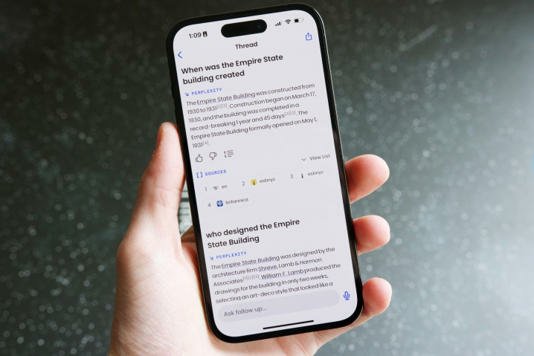
There’s one other huge aspect of Perplexity AI, and that’s its ability to clearly show where its answers are coming from.
After each answer you get, Perplexity AI shows all of the sources that it pulled its response from. If you want a closer look, you can tap the View List button to see a breakdown of each article Perplexity AI looked at and tap on it to read the sourced article directly in the app.
No ChatGPT application is perfect, even with advancements being made in GPT-4 and GPT-5. AI chatbots make mistakes, as we’ve clearly seen over and over again. But by clearly highlighting sources directly in the app, Perplexity AI removes any lingering doubts you may have about a response you get. Not even the official ChatGPT website clearly marks its sources, and the approach here is more visible and apparent than how Bing Chat handles sourcing. It may seem like a small feature to some people, but it’s allowed me to trust Perplexity AI far more than the regular ChatGPT site — and that’s a big deal.
I think I’m a ChatGPT believer
Up until this point, I’ve never found myself particularly excited about ChatGPT. The technology is impressive, yes, but it’s always felt a bit cumbersome and awkward. Bing Chat is baked right into the Bing app, but it’s surrounded by a load of other Bing features I just don’t care about. There are plenty of third-party ChatGPT apps on the App Store, but almost all of them require some kind of in-app purchase. And while you can replace Siri with ChatGPT on your iPhone, there are a few more steps involved than I care to make.
Perplexity AI solves all of that for me. The interface is simple, it’s free, and all you need to get started is to download and open the app. I’m not sure any of that will make me a ChatGPT superfan, but this is the first time I’ve found a ChatGPT app that I actually enjoy and want to keep using. And I think that’s mighty impressive.
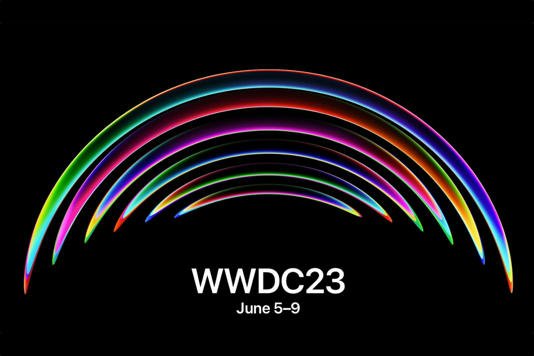
Apple has announced its annual Worldwide Developers Conference will take place online between 5 June and 9 June, with the company tipped to announce plenty that should pique the interest. If the rumours are true, Apple will announce its first mixed reality headset, dubbed Reality Pro, during the event. We can also expect the unveiling of iOS 17, iPadOS 17, macOS 14, watchOS 10, and tvOS 17 at the very least.
Apple’s WWDC23 event will be held online with developers able to take part for free. There will also be an in-person component for some members of the developer community as well as students. That’ll take place on the opening day, with those in attendance able to watch the same opening keynote that the rest of us will watch at home.
Mark your calendars “Mark your calendars for an exhilarating week of technology and community,” Apple’s developer website says. “Be among the first to learn the latest about Apple platforms, technologies, and tools.” Apple goes on to say that developers will be able to work with its own in-house experts, as well as other developers, at no extra cost beyond their $99 annual developer fee.
While the event is, as the name suggests, supposed to be aimed at developers, that opening keynote is where a lot of the focus will be. Apple’s rumoured to finally be ready to share its Reality Pro headset with the world. It isn’t clear when it will go on sale, but it’s likely that Apple will allow developers time to build apps for the device before it is made available to buy.
Buying it won’t be a cheap endeavour, either. Apple’s thought to be ready to slap a $3,000 price tag on the product. That might make the software announced during WWDC the most interesting for many — the iPhone, iPad, Mac, Apple TV, and Apple Watch will all see new software debuted. A months-long beta program will follow with the software likely to be made available in or around September.
If you’ve ever thought of rooting your phone or dipping your toes into the world of modding many of the best Android phones, the chances are you’ve heard of Magisk. But what is Magisk? In a nutshell, Magisk is a tool that can be used to gain root access on your device, similar to legacy tools like SuperSU, but it’s not limited to just that. Developed by XDA Senior Recognized Developer topjohnwu, Magisk is a portal that enables all sorts of modifications on your Android phone. Apart from root access, you can also try out a whole lot of derivative components called “Magisk modules” that you can install for different purposes.
There are modules for theming, ad blockers, enabling Camera2API, and a lot of other system-level modifications you can’t do otherwise. If you’re a power user and want to extend the functionality of your phone and push it to its limits, you need to try out Magisk. If all this sounds fun to you, we’ll tell you how you can install Magisk on your Android device to customize it and do things you never thought of doing on your phone.
How to install Magisk
Installing Magisk requires you to have a device with an unlockable bootloader. If you’ve already unlocked the bootloader on your phone, you’re good to go. If you haven’t and you don’t know what we’re talking about, we recommend you head over to the XDA forums, search for your device, and then look for a guide to unlocking the bootloader. There’s no universal method for this, as it differs from phone to phone. Once you’ve unlocked the bootloader, you can proceed further
Unlocking the bootloader will wipe all the data on your smartphone and in some cases, may even void your warranty. It’s advisable to back up all your data before performing these steps. It’s also important to understand that not following the steps correctly may result in a bricked phone so make sure you know how to recover your phone back to its original state in case you end up in a situation like that. Furthermore, Magisk may cause issues with a few streaming and banking apps, so if those are absolutely vital to you, proceed with caution.
Before we begin, make sure you have access to a PC/Mac with ADB and Fastboot installed. Windows users are also advised to install the latest OEM USB driver for your Android device.
Step 1: Identifying the type of boot image Download the latest version of the Magisk app from the project’s GitHub repository. Since the APK of Magisk is hosted outside the Google Play Store, you may need to allow sideloading apps from unknown sources first and then manually install the downloaded package.
After installing, open the Magisk app. You should see a screen like this:
Now, we need to note down the values of the following parameters:
Ramdisk A/B SAR
Step 2: Locating the stock boot image. In order to patch the boot image for your device, you need to extract it from the official firmware packages. In case you’re using a custom ROM like LineageOS, the flashable ZIP file contains the boot image.
Case I: You have access to the recovery-flashable ZIP file
If you have a device that still uses the A-only partition scheme, you can find the ‘boot.img’ right inside the recovery-flashable ZIP file. Just extract it using a suitable archiver program.
Notice the boot.img file inside POCO M3’s recovery ZIP.
However, if your device utilizes the A/B partition scheme, then the boot image and other partition images are further packed inside a file named payload.bin as shown below.
As you can see, the recovery ZIP of the Google Pixel 5 contains a payload.bin file. In that case, you have to extract the payload.bin file first, then use one of the community-developed payload.bin unpackers to get the boot.img out of it. We strongly suggest you opt for the extractor written in Go by XDA Member ssssut, as it is cross-platform and has been actively developed.
We’re all excited spectators in the big AI showdown, and there’s a lot of speculation and gossip among the crowds. Which AI model is the best? Are ChatGPT and Siri similar? Will ChatGPT eventually replace Siri?
While Siri and ChatGPT are both driven by AI, that’s pretty much where the similarities end. So, we’ll look at how Siri and ChatGPT differ and why they’re both equally useful in their own unique ways.
Siri vs. ChatGPT: How Are They Different?
The most fundamental difference between the two arises in their purpose. While ChatGPT is a language-based model with the ability to hold a human-like conversation, Siri is a virtual assistant that responds to commands and performs various tasks on Apple devices.
It’s safe to say both occupy completely different niches despite being run by AI. It’s not much of a race if they’re both playing a different sport, is it? We’ll dissect some specific differences down below so that you know which is better suited for your purpose.
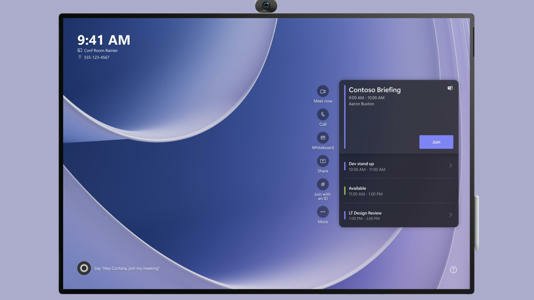
Microsoft has announced a second generation of its Surface Hub 2S interactive whiteboard will be arriving later this year, equipped with new features built around Microsoft’s Teams conferencing software. The updated enterprise device features the same 50-inch and 85-inch design as the current Surface Hub 2S, and will be the first touch-enabled board to run Teams Rooms on Windows.
Microsoft Teams Rooms is meant for all-in-one conferencing systems designed to replace individual remote meeting devices like webcams and TVs. Microsoft says that the Teams Rooms on Windows experience adds new features like additional video layouts, chat channel modes, and management capabilities for both users and admins. It also features a new user interface that resembles that seen on Teams Rooms for Android devices (spotted by Windows Central), but details on the new OS are otherwise slim.
Older Surface Hub 2S models currently running Windows 10 Team Edition will be offered the chance to migrate over to the Teams Rooms on Windows experience “at a future date.” Microsoft will continue to support Windows 10 Team Edition with security updates and bug fixes until October 14th, 2025, after which all Windows 10 products will be retired.
Microsoft hasn’t announced a release date for the 2nd gen Surface Hub 2S, nor has it provided any pricing information. If the existing model is anything to go by though, it certainly won’t be cheap — prices started at $8,999.99 when it was released back in 2019. Microsoft originally planned to release a cartridge that would upgrade the GPU and processor for the original Surface Hub 2S to facilitate tiling and rotation support. The cartridge was then scrapped in favor of a “major software update” based on the then-latest release of Windows 10.
That was three years ago. Software updates have been minor and there’s no word if Microsoft will be upgrading the 2nd gen Surface Hub 2S’s hardware. Microsoft hasn’t even confirmed if the upcoming model will finally support the tiling and rotation features it promised back in 2018. We’ve reached out to Microsoft for more information and will update this story should we hear back.
This article may contain affiliate links that Microsoft and/or the publisher may receive a commission from if you buy a product or service through those link
Futurist and former Google engineer Ray Kurzweil said that he believes humans will reach immortality by 2045, according to Youtuber Adagio who discussed Kurzweil’s theory in a two-part Youtube series.
Kurzweil believes that humanity is moving toward a singularity in 2045 which is powered by exponential growth – a theory that says that when an industry becomes interesting, more resources are invested into it, meaning that more research can be done and causing the industry to advance at greater speeds as time goes on.
The singularity will come at the end of six epochs, according to Kurzweil who added that we have gone through four: physics, chemistry, DNA and biology and brains and technology. According to the theory, humanity is currently in the midst of the fifth epoch which is human technology and human intelligence.
After humanity achieves the sixth epoch, Kurzweil believes that we will saturate our intelligence into the rest of the universe. He believes that humans, specifically, are intended to do this because the fact that we haven’t found proof of alien life yet means that it doesn’t exist.
Though twice-impeached former president Donald Trump has been continually ramping up his attacks on Ron DeSantis, in preparation for DeSantis potentially running against him for president in 2024, the Florida governor largely hasn’t fired back. But, even if he did, the hosts of “The View” are pretty sure he’d miss, specifically because “he’s a dweeb.”
In discussing DeSantis once more on Wednesday’s episode, Alyssa Farah Griffin reiterated her opinion on the Florida governor, and how good a chance he’d actually have in competing against Trump.
“I have been saying at this table for months, I think Ron DeSantis is the most overhyped politician in America,” she said. “I think this notion that he’s who’s gonna save the GOP from Trump, and he’s gonna score the nomination, it’s overhyped! He had a good midterm election being re-elected in Florida–”
At that, Whoopi chimed in to poke fun at the idea of DeSantis having “a good midterm election,” exasperatedly asking “who else were they gonna elect?!”
Actor Chris Pine, who played Nicholas Devereaux in the popular 2004 movie “The Princess Diaries 2: Royal Engagement,” has recently shared his thoughts on the possibility of a third installment in the franchise. In an interview with Entertainment Tonight, Pine was asked if he would be interested in reprising his role in a new “Princess Diaries” movie.
Pine responded positively, saying that he had a great time making the second movie and would love to work with director Garry Marshall and co-star Anne Hathaway again. However, he also acknowledged that there are many factors to consider when making a movie, and he doesn’t know if a third “Princess Diaries” movie will ever come to fruition.
Since the interview, there has been no official announcement about a third “Princess Diaries” movie, but fans of the franchise continue to hope for a reunion of the original cast. In the meantime, Chris Pine is keeping busy with a variety of other projects, including the upcoming “Wonder Woman 1984” movie and the sci-fi thriller “Violence of Action.”




 !!! Explore Journey !!!